
Views: 0 Author: Site Editor Publish Time: 2026-07-26 Origin: Site
Transitioning from friction-based towel drying to aerodynamic evaporation introduces a physical reality to the post-shower routine: hardware specifications only account for half of the drying equation. A high-velocity motor generates massive airflow, but if that air fails to reach the skin, moisture remains. Buyers frequently experience a discrepancy between manufacturer-stated drying times and actual daily use. This gap rarely stems from mechanical failure. Instead, improper standing position, airflow obstruction, and user hesitation act as the primary culprits for inefficient performance.
Understanding how posture, weight distribution, and machine configuration interact provides the framework needed to operate these devices effectively. Selecting a body dryer requires evaluating physical mobility, ergonomic safety, and spatial requirements. Mastering the correct stance and understanding sensor mechanics allows users to eliminate damp spots, prevent premature machine shut-offs, and achieve complete evaporation rapidly.
Airflow Geometry: Optimal drying requires specific stances to eliminate "wind shadows" (areas blocked by limbs), directly impacting the time required for full evaporation.
Sensor Dependency: Floor-mounted models rely on precise weight distribution and bare skin-to-sensor contact for activation; improper stance or footwear can trigger premature auto-shutoff.
Ergonomic Realities: Prolonged static standing can induce muscular fatigue and circulatory strain; evaluating a machine’s drying speed is critical for users with mobility or stamina limitations.
Hardware Alignment: The choice between overhead, wall-mounted, and base-plate dryers must align with the user's ability to maintain the required posture for that specific airflow trajectory.
A successful drying cycle achieves complete moisture removal within two to three minutes without causing thermal discomfort. This outcome relies on fluid dynamics. Evaporation accelerates when maximum skin surface area receives direct, high-velocity air currents. If the air cannot make contact with the moisture, the evaporation process stalls.
The most significant barrier to efficient evaporation is the wind shadow effect. Wind shadows are aerodynamic blockages created by the user's own body. Crossed arms, closed legs, or a hunched posture deflect air away from adjacent skin surfaces. This creates physiological blind spots. The underarms, groin, areas behind the knees, and the lower back require intentional stance adjustments to receive adequate airflow. Standing rigidly with arms at the sides shields the inner arms and torso from air currents, extending the total drying time.
Evaluating a machine requires looking beyond raw cubic feet per minute (CFM) output. High CFM only works if the air reaches the target. Buyers must evaluate CFM based on how much physical repositioning the user needs to perform. Unidirectional airflow requires the user to expose different body parts to the stream actively. Understanding this dynamic sets realistic expectations for the physical involvement required during the drying cycle.
To further illustrate the impact of wind shadows, consider the surface area of an average adult. When standing in a neutral, relaxed posture, up to 30% of the skin's surface area remains obscured from vertical or horizontal airflow. This obscured area holds water droplets that cool rapidly, leading to the shivering effect many users complain about when first testing a unit. By simply elevating the arms 45 degrees and widening the stance, that obscured surface area drops to less than 5%, allowing the high-velocity air to shear water droplets off the skin before evaporation even begins.
Temperature also plays a role in this physical equation. Heated air holds more moisture than cold air, accelerating the phase change of water to vapor. However, if the user adopts a closed posture, the heated air bounces off the exterior limbs, failing to warm the trapped moisture in the body's folds. This results in a frustrating scenario where the outer extremities feel hot while the core remains damp and cold.
Posture Type | Exposed Surface Area | Estimated Drying Time Penalty | Primary Wind Shadows Created |
|---|---|---|---|
Rigid (Arms down, feet together) | 70% | +40% time | Underarms, inner thighs, groin |
Huddled (Arms crossed, hunched) | 50% | +80% time | Chest, stomach, neck, underarms |
A-Stance (Legs apart, arms raised) | 95% | Baseline (Optimal) | Minimal (Requires slight pivoting for back) |
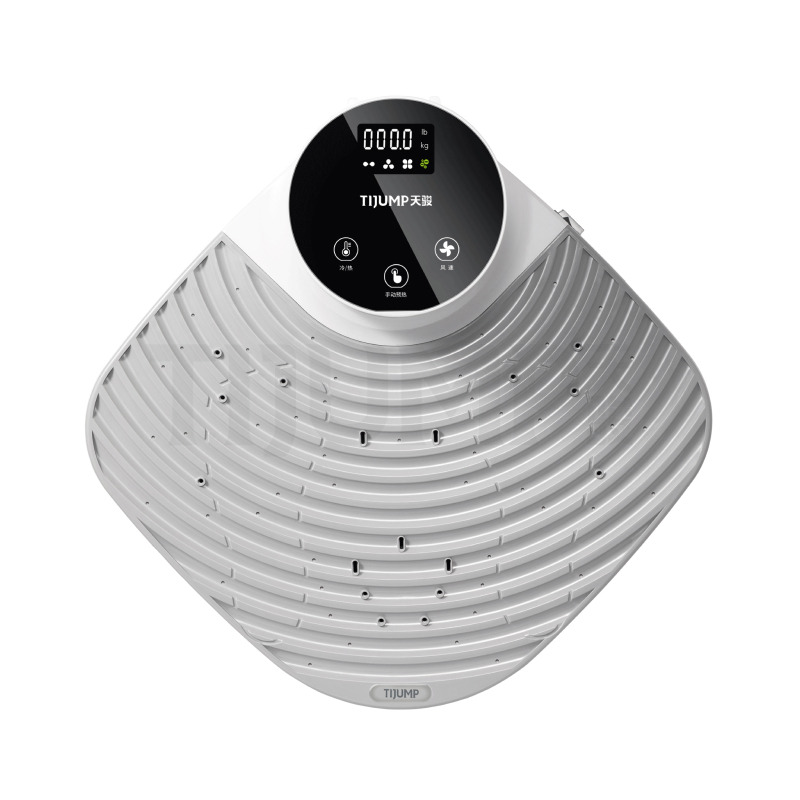
The physical design of the drying unit dictates the exact posture the user must adopt. Different configurations push air from different angles, requiring specific stances to maximize coverage. Matching the hardware to the user's physical capabilities prevents daily frustration.
Floor-mounted units push air vertically from the ground up. Utilizing this design effectively requires the A-stance. The user stands with legs shoulder-width apart. This posture creates a channel for the upward vertical airflow to travel along the inner legs, reach the torso, and enter the underarm area. Standing with feet together causes the air to hit the outer legs and deflect outward, missing the upper body entirely.
Base plate models often feature angled louvers designed to create a vortex effect. This vortex wraps around the legs, but it still relies on the user maintaining an open stance. If a user has knee or hip issues that prevent a shoulder-width stance, a floor-mounted unit will underperform, leaving the upper torso damp.
Overhead and wall-mounted configurations project air downward or horizontally. Because the air source remains fixed above or to the side, the user must engage in rotational movement to ensure even drying. Turning 360 degrees slowly allows the directional air to sweep across the front, sides, and back of the body. This requirement impacts users with balance concerns or limited mobility. Continuous rotation on a potentially damp floor requires stability and coordination.
Wall-mounted units installed in shower cabins also require adequate spatial clearance. If the cabin is too narrow, the user cannot rotate without bumping into the glass or fixtures, forcing them to remain static and resulting in uneven drying.
Advanced configurations, such as an air shower body and feet dryer, utilize multidirectional nozzles. These systems surround the user with airflow from multiple angles simultaneously. Attacking moisture from the top, sides, and bottom significantly reduces the burden of strict postural compliance. The user stands relatively still while the machine does the aerodynamic work, making these systems highly suitable for individuals with restricted movement.
Complex postural requirements represent the primary hurdle to user adoption. While buyers focus on hygiene or privacy features, the daily reality of holding specific stances determines consistent use. If a device requires uncomfortable contortions to dry the lower back, users revert to using a towel.
The physical stance a user takes directly influences the operational reliability of the equipment. Modern drying platforms utilize complex sensor arrays to ensure safety and efficiency. Connecting the physical stance to these sensor mechanics is necessary for uninterrupted operation.
Advanced base-plate models utilize a combination of weight distribution and capacitive skin-contact sensors. These sensors form a loop that detects the presence of a human and the direct contact of bare skin. This dual-verification system provides seamless safety, ensuring the machine shuts off the moment the user steps away. However, this precision makes the machine highly sensitive to how the user stands.
Shifting weight unevenly, leaning heavily to one side, or stepping off-center disrupts the pressure sensors. Attempting to stand on the platform while wearing slippers, or placing a bath mat over the vents, interrupts the capacitive sensor loop. The machine interprets the lack of direct skin contact or the uneven weight distribution as an exit signal, triggering auto-shutoffs in the middle of the drying cycle. Operating a body drying machine requires a deliberate, centered, and barefoot stance.
Purchasing a base-plate model for users who cannot stand flat-footed, struggle to maintain a centralized center of gravity, or require supportive footwear in the bathroom leads to operational failure. The sensors constantly misread the user's presence, rendering the machine unusable.
To troubleshoot sensor issues, users should regularly clean the platform surface. Soap scum or hard water deposits can create a microscopic barrier that interferes with capacitive sensors. Wiping the base plate with a mild descaler ensures the skin-to-sensor connection remains strong. Additionally, users should verify that the unit sits perfectly level on the floor; an uneven installation causes the internal weight sensors to calibrate incorrectly, leading to phantom shut-offs even when the user stands perfectly still.
Sensor Type | Function | Common User Error Causing Shut-off | Correction Strategy |
|---|---|---|---|
Capacitive Skin Sensor | Detects bare human skin | Wearing shower shoes or socks | Stand barefoot directly on the platform |
Weight Distribution Sensor | Detects mass and center of gravity | Leaning on a wall or standing on one leg | Distribute weight evenly across both feet |
Thermal Overload Sensor | Prevents motor overheating | Placing a towel over the air intake vents | Keep the surrounding floor area clear of obstructions |
Drying time represents a critical ergonomic and occupational health consideration. The longer a machine takes to evaporate moisture, the longer the user remains in a static standing position. Evaluating the physiological impact of this requirement ensures safe daily use.
Clinical data regarding prolonged static standing on hard surfaces highlights several risks. Remaining stationary while wet accelerates muscle fatigue and causes sore feet. The lack of movement restricts blood supply to the muscles, triggering lower back stiffness. Static standing without active muscle engagement contributes to leg swelling or varicose veins over time. The bathroom environment, with hard tile floors and the physical state of the user post-shower, exacerbates these physiological impacts.
Users should adapt professional ergonomic pivot principles to mitigate these risks. Instead of locking the knees and standing rigidly, engage the core and maintain a neutral spine. When redirecting airflow to different parts of the body, pivot from the hips rather than twisting the lower back. Dynamic weight shifting—transferring weight slightly from one foot to the other—protects the joints, encourages blood flow, and exposes different angles of the body to the air stream.
When evaluating accessibility for elderly, injured, or disabled users, required standing time serves as the most critical metric. High-velocity models that minimize standing time are essential. Buyers should also seek out models designed to safely accommodate seated use, removing the ergonomic strain of static standing entirely.
For users recovering from surgery or dealing with chronic joint pain, the transition from the shower to the drying platform must be seamless. Installing grab bars adjacent to the drying unit allows users to maintain balance while shifting their weight. This simple addition transforms a potentially hazardous balancing act into a stable, controlled movement, allowing the user to focus on exposing different body parts to the airflow without fear of slipping.
User errors frequently degrade machine performance, even with high-end equipment. Understanding and mitigating these common positioning mistakes ensures the hardware operates at peak efficiency.
When hit by a high-velocity stream of air, users instinctively curl up or cross their arms to retain warmth. This huddle posture traps moisture in the joints, under the arms, and within torso folds. Closing off the body creates massive wind shadows, ensuring the user remains wet.
Standing off-center on a base plate triggers sensor shut-offs and physically blocks critical air vents. Users often place towels on the platform for comfort or wear shower shoes. This obstructs the upward airflow trajectory and blinds the safety sensors, causing the machine to malfunction.
Standing completely still on a unidirectional dryer prolongs wetness. If the air blows from the front, the back remains shielded. Fluid dynamics do not support the expectation that air will wrap around a static object perfectly. Failing to rotate or shift position leaves moisture trapped in bodily blind spots.
Users face a trade-off between thermal comfort and drying efficiency. Standing closer to the nozzle or huddling retains body heat but reduces the surface area exposed to the air, slowing down evaporation. Standing open and exposed maximizes air velocity and surface area contact, resulting in rapid drying. Prioritizing an open stance yields a faster, more efficient drying cycle.
Another frequent error involves the sequence of drying. Users often attempt to dry their hair and body simultaneously using the same airflow. This splits the aerodynamic focus. For optimal results, users should allow the machine to focus on the heavy water droplets on the torso and legs first, using a dedicated towel for the hair, or utilizing a wall-mounted unit specifically angled for upper-body coverage.
Measure your designated shower exit space to ensure adequate room to adopt a wide stance and rotate safely without hitting walls or glass enclosures.
Match the machine configuration to your daily mobility; select multi-directional or seated models if you experience joint pain or balance issues.
Review the specific sensor requirements of a model before purchase, ensuring you can operate the device barefoot and centered.
Practice dynamic weight shifting and hip pivoting during use to reduce lower back strain and accelerate the evaporation process.
A: The optimal position is the A-stance. Stand with your feet shoulder-width apart, keep your arms slightly elevated away from your torso, and engage your core. This maximizes skin surface area exposure to the airflow and protects your posture.
A: Auto-shutoffs are triggered by sensor interruption. This happens if you stand off-center, shift your weight too heavily to one side, or attempt to use the machine while wearing slippers, which blocks the capacitive bare-skin sensors.
A: Yes, specific models are designed for seated use. Sitting alters airflow dynamics, often blocking the back of the thighs and buttocks. You need to shift your weight or use a slatted shower chair to ensure complete drying.
A: Absolutely. Overlapping limbs, crossed arms, or a hunched posture create wind shadows. These blockages trap moisture in bodily blind spots, significantly extending the total time required for full evaporation.
A: Prolonged static standing on hard surfaces causes muscle fatigue, blood pooling in the legs, and joint strain. Use active pivoting, shift your weight slightly, and choose a high-velocity model for rapid drying cycles.
A: Yes. While base plates provide upward vertical airflow, gentle hip pivoting and 360-degree rotation are necessary to ensure the air reaches your lower back and posterior effectively.


