
Views: 0 Author: Site Editor Publish Time: 2026-09-07 Origin: Site
Few things ruin a morning routine faster than a compact steamer spitting boiling water onto a delicate silk blouse or directly onto your hands. This common operational failure happens when users tilt the device past its vertical axis. Compact units face a strict physical constraint. They must boil water in a small, unpressurized reservoir. When you tilt the device to steam a collar on a bed or reach an awkward angle, gravity pulls liquid water straight into the steam nozzle.
This creates a direct conflict between the user's need for ergonomic, multi-angle steaming and the gravity-dependent design of entry-level devices. You want the flexibility to press garments horizontally. The hardware, however, demands strict vertical alignment. Overcoming this limitation requires specific engineering advancements. Premium models utilize internal pumps and secondary heating elements to prevent rogue droplets. Understanding these hardware differences provides a clear framework to evaluate which devices actually support horizontal or angled use without leaking.
Mechanism Over Marketing: True multi-angle steaming relies on electronic water pumps rather than gravity-fed heating elements.
Secondary Heating is Critical: Devices functioning as a jet steam ironing machine utilize heated soleplates to vaporize rogue droplets before they escape the nozzle.
Hardware Meets Technique: Proper fabric tensioning techniques can eliminate the need to tilt the device entirely, bypassing hardware limitations.
Form Factor Limitations: Even the best handheld units have angle limitations; high-volume or complex draping tasks often necessitate a standing garment steamer.
Maintenance Impacts Performance: Mineral buildup (calcification) is a primary cause of late-stage leaking, requiring strict descaling routines regardless of the anti-leak technology used.
Traditional gravity-fed boilers rely on a simple physical principle. Water sits in a reservoir directly above or adjacent to a heating element. As the element heats up, a mechanical valve allows water to drip down into the boiling chamber. Steam then rises and exits the nozzle. This system works perfectly when the device remains perfectly upright. However, tilting the unit disrupts this delicate balance. Liquid water bypasses the heating element entirely. It flows directly into the steam channel and exits the nozzle as boiling droplets.
Electronic pump systems solve this orientation problem. Instead of relying on gravity, a small internal pump draws water from the tank. It pushes this water into the heater in highly controlled micro-doses. Because the pump forces the water through a sealed line, the device's physical orientation becomes largely irrelevant. The heating element only receives the exact amount of water it can instantly vaporize. This mechanical control prevents pooling and significantly reduces the risk of hot water escaping.
To understand the failure points of gravity-fed systems, consider the internal fluid dynamics during operation:
The 45-Degree Threshold: Once tilted past 45 degrees, the water level in the reservoir shifts, exposing the gravity feed hole to air while submerging the steam exhaust port in liquid.
Thermal Shock: Cold water floods the aluminum heating block, instantly dropping its temperature below the boiling point.
Pressure Expulsion: The remaining steam pressure inside the chamber forces the unheated liquid water out through the nozzle, resulting in heavy spitting.
Even with perfect water delivery, physics presents another challenge. Steam naturally reverts to liquid water when it contacts a colder surface. As hot vapor travels from the boiler to the exit nozzle, some of it cools and condenses inside the steam head. This creates small pools of liquid water just behind the exit holes.
Operating the device vertically allows this condensation to safely drip back down into the heating chamber. Tilting the unit downward changes the exit path. Gravity forces the pooled condensation out through the nozzle. This sudden release of water spots fabrics and creates a scalding hazard. Managing this condensation requires either specific user techniques or advanced secondary heating hardware.
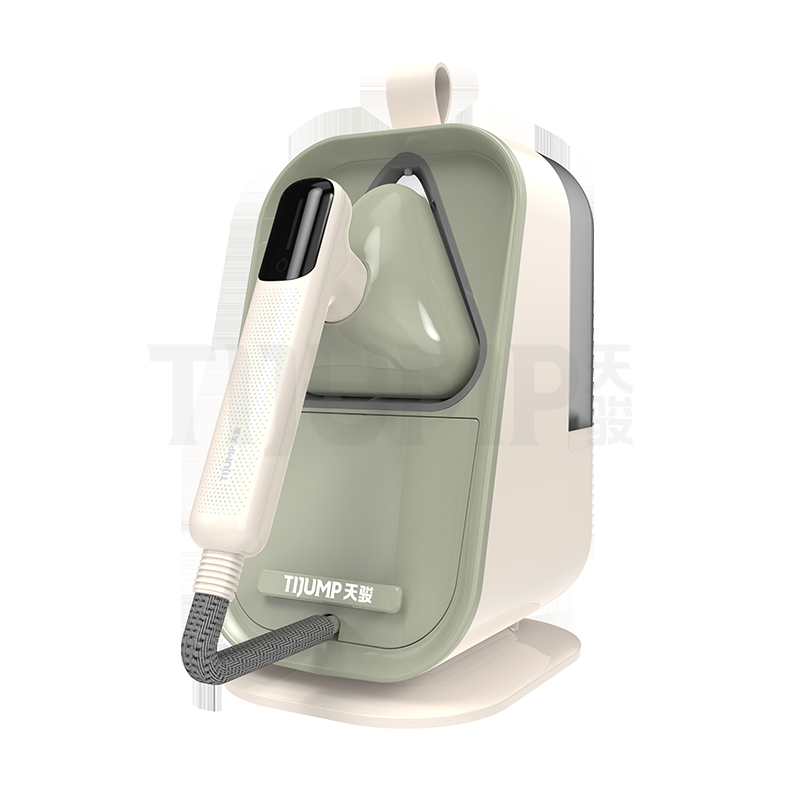
Manufacturers often market premium units with "360-degree" technology. In technical terms, this means the device utilizes a sealed electronic pump rather than a gravity drip. A true 360-degree handheld garment steamer can operate completely upside down without leaking. When evaluating these systems, look at pump consistency and pressure ratings. High-quality solenoid pumps maintain a steady flow rate regardless of the water level in the tank. This ensures continuous vapor production and prevents the sputtering associated with cheaper mechanical pumps.
Solenoid pumps utilize an electromagnetic coil to move a plunger back and forth. This rapid movement creates a vacuum that pulls water from the reservoir and forces it into the boiler under pressure. Because the system remains pressurized and sealed, ambient air cannot enter the line, and water cannot flow backward or escape through unintended channels, regardless of how you hold the handle.
Advanced models incorporate a heated metal faceplate at the nozzle. This acts as a secondary boiler. Any steam that condenses inside the head hits this hot metal plate and instantly vaporizes again before it can escape. This technology effectively transforms the unit into a jet steam ironing machine. The heated soleplate not only prevents leaks but also unlocks dual-use capability. You can press the hot metal directly against the fabric on an ironing board. This provides the crisp creases of a traditional iron alongside the wrinkle-relaxing power of continuous vapor.
The integration of a secondary heater requires sophisticated thermal management. The primary boiler must generate enough steam volume, while the secondary plate must maintain a temperature high enough to vaporize droplets without scorching delicate synthetics. Devices equipped with this dual-heating architecture represent the most reliable defense against tilt-induced leaking.
Ergonomic design plays a massive role in leak prevention. Some modern units feature articulating steam heads. A pivoting head allows you to change the angle of the steam application while keeping the primary water reservoir safely vertical. You can bend the nozzle 90 degrees to press a collar flat on a table. The boiler and water tank remain upright, completely bypassing the gravity problem. This mechanical workaround provides horizontal flexibility without requiring expensive pressurized pump systems.
Internal hardware seals determine a unit's baseline reliability. A leak-proof water tank requires thick silicone gaskets around the filling port. Pop-off travel caps must withstand luggage pressure and rapid temperature changes without degrading. Inside the tank, structural baffles prevent water from sloshing violently during use. Rapid arm movements cause internal waves. Without baffles, these waves can push liquid water past the seals and into the steam chamber. High-quality physical seals ensure the water stays exactly where it belongs.
When inspecting a unit for structural integrity, check the following components:
O-Ring Material: EPDM or high-grade silicone resists thermal degradation better than standard rubber.
Cap Threading: Screw-on caps provide superior leak resistance compared to push-in rubber plugs.
Tank Seating: The connection point between a removable tank and the main body must feature a spring-loaded valve that seals instantly upon removal.
Compact units excel in specific scenarios. They are the ideal choice for travel, quick morning touch-ups, and processing single garments. Their small footprint makes them perfect for apartments with limited storage space. However, these benefits come with strict trade-offs. You must accept a smaller water capacity, which limits continuous run time. They also carry heavier in-hand weight since you hold the entire water reservoir. Finally, their compact nature increases the risk of user error. Tilting them incorrectly remains the leading cause of water spotting.
Upright models eliminate the tilt problem through structural design. The heavy boiler and water tank remain stationary and upright on the floor. The device sends only dry vapor up the flexible hose to the nozzle. Because you only hold a lightweight plastic or metal head, you can twist, turn, and tilt it at any angle. A standing garment steamer effectively eliminates tilt-based leaks at the application point. You must evaluate the footprint and setup time. These units require dedicated floor space and take slightly longer to reach optimal operating temperatures.
The floor-based boiler design also allows for significantly larger heating elements. While a compact unit might utilize a 1000-watt heater, upright models frequently employ 1500 to 2000-watt elements. This increased wattage translates directly to higher steam volume and faster recovery times between strokes.
Retail environments, large households, and heavy fabric processing require robust solutions. Advanced upright models feature adjustable pressing boards and pressurized steam generators. A multi level standing garment steamer provides a rigid surface to press against. This mimics the results of an ironing board while maintaining vertical convenience. The pressurized generator forces vapor deep into thick materials like denim or wool coats. When comparing efficiency, these multi-level setups process large volumes of clothing significantly faster than even the most premium handheld models.
Operational Hardware Comparison
Equipment Category | Boiler Location | Tilt Tolerance | Primary Advantage |
|---|---|---|---|
Gravity-Fed Compact | In-hand | Low (< 45 degrees) | Lightweight, fast heat-up |
Pump-Driven Compact | In-hand | High (360 degrees) | Horizontal pressing capability |
Standard Upright | Floor base | Maximum (Head only) | Continuous run time, zero head leaks |
Pressurized Upright | Floor base | Maximum (Head only) | Deep fiber penetration, rigid backing |
Hardware limitations often disappear when you apply professional techniques. The most critical skill is fabric tensioning. Grab the bottom hem of the shirt or dress and gently stretch the garment downward. Creating a taut surface allows the vapor to penetrate the fibers directly. You can glide the garment steamer vertically from top to bottom. This downward stroke effectively removes wrinkles without ever requiring you to tilt the device horizontally. Proper tensioning makes basic gravity-fed models perform like premium units.
Different fabrics require different tensioning approaches. Heavy cotton shirts need a firm, steady pull to open the tight weave. Delicate silks require only the lightest touch to avoid distorting the seams. Mastering this physical manipulation of the garment reduces your reliance on the machine's internal hardware.
Operational technique directly impacts water spotting. Establish a baseline distance of 6 to 8 inches when processing delicate fabrics like silk or chiffon. This air gap prevents accidental droplet transfer. Stroke speed also matters. Rapid, sweeping motions cause the water inside the tank to slosh violently. This sloshing leads to sputtering, even in tanks equipped with internal baffles. Move the nozzle slowly and deliberately. For stubborn creases, use a wrinkle release spray as an adjunct. This chemical assistance relaxes the fibers, preventing you from forcing the device into a dangerous horizontal pressing angle.
Fabric Processing Guidelines
Fabric Material | Recommended Distance | Tension Level | Stroke Speed |
|---|---|---|---|
Silk / Chiffon | 6 - 8 inches | Light | Moderate |
Polyester Blends | 2 - 4 inches | Medium | Slow |
Heavy Cotton | Direct Contact (if heated) | Firm | Very Slow |
Wool / Tweed | 1 - 2 inches | Medium | Slow with pauses |
Patience prevents ruined garments. You must allow the device to reach its full operating temperature before engaging the steam trigger. Activating the pump too early pushes unheated water straight through the nozzle. Once the indicator light signals readiness, press the steam button while pointing the nozzle away from your fabric. This initial burst clears any residual condensation trapped in the line from the previous session. Only apply the nozzle to your clothing after you see a steady, dry vapor stream.
Follow this exact sequence for cold starts:
Fill the reservoir with room-temperature distilled water.
Power on the unit and wait for the solid indicator light (usually 30 to 45 seconds).
Point the nozzle at a towel or empty space.
Engage the trigger for 5 seconds to purge cold water from the internal hoses.
Begin processing the garment.
Hardware neglect guarantees eventual leaking. Tap water contains dissolved minerals like calcium and magnesium. As water boils, these minerals remain behind, coating the internal heating element. This calcification alters internal pressure dynamics and destroys heating efficiency. The unit struggles to vaporize water quickly, leading to heavy sputtering and white mineral flakes shooting onto your dark clothes. Establish a realistic maintenance schedule. If you use hard tap water, run a descaling solution of equal parts white vinegar and distilled water through the system monthly. Flush it twice with pure water afterward.
The descaling process requires specific attention to detail. Do not simply run vinegar through the machine and immediately use it on clothing. The acidic residue will damage delicate fibers. After running the vinegar solution, you must run at least two full tanks of pure distilled water through the boiler to neutralize the internal components. Inspect the nozzle holes with a flashlight; if you see white crust remaining, use a wooden toothpick to gently clear the exhaust ports.
Buyers must navigate the inverse relationship between leak-proof design and raw output. A truly leak-proof, pump-driven handheld design requires dense internal components. To keep the weight manageable, manufacturers must reduce the water tank size. This limits your continuous steam time to roughly 10 to 15 minutes. Conversely, units with massive water tanks rely on simpler gravity feeds to keep costs and weight down. You must choose between horizontal flexibility and the ability to process an entire wardrobe in one session.
Consider the physical strain of operating the equipment. A compact unit holding 300ml of water weighs significantly more than the plastic nozzle of a floor-standing model. If you process more than three garments daily, the ergonomic toll of holding the entire water supply in your hand outweighs the convenience of a compact footprint.
Basic gravity-fed models offer an attractive entry point. They handle vertical hanging garments perfectly well. However, integrating electronic solenoid pumps and secondary heated soleplates significantly increases manufacturing complexity. You must determine your personal return on investment based on time saved and garment preservation. If you are a quilter, a frequent traveler, or someone who prefers pressing collars flat on a bed, the premium engineering of 360-degree technology pays off immediately. If you only process hanging dress shirts once a week, a standard vertical unit offers better value.
Take the following steps to optimize your garment care routine:
Audit your primary use cases to determine if you actually need horizontal pressing capabilities.
Check product specifications specifically for terms like "electronic pump," "dual-heating," or "pivoting head" before buying a compact unit.
Adopt the hem-pulling tension technique to improve results with your current vertical device.
Switch to distilled water immediately if your current unit shows signs of white mineral dust or sputtering.
A: Basic models use gravity to feed water into the heater. Tilting the device causes liquid water to bypass the heating element entirely. This unheated water flows directly into the steam channel and exits the nozzle as boiling droplets.
A: You can only do this if the device features an electronic pump or a heated soleplate. These "360-degree" models control water flow mechanically. Standard gravity-fed models will leak heavily if used horizontally.
A: A gravity-fed unit relies on vertical orientation to drop water into the boiler. A pump-driven unit uses an internal electronic mechanism to actively pull water from the tank and push it into the heater, allowing for multi-angle use.
A: Grab the bottom hem of the garment and pull downward gently. This creates a taut, flat surface. You can then glide the nozzle vertically down the fabric, removing wrinkles without ever changing the device's upright angle.
A: Yes. The heavy water tank and boiler remain stationary on the floor. Only dry vapor travels up the hose to the nozzle. Because there is no liquid water in the handle, you can tilt the head freely without leaking.
A: Always allow the device to reach full operating temperature first. Then, point the nozzle away from your garment and press the steam button for a few seconds. This initial burst clears any pooled water trapped in the line.
A: Yes, especially in hard water areas. Tap water contains minerals that calcify on the heating element. This buildup ruins heating efficiency and causes the device to sputter water and shoot white mineral flakes onto your clothes.


