
Views: 0 Author: Site Editor Publish Time: 2026-09-07 Origin: Site
Installing a shared bathroom appliance introduces a specific ergonomic challenge. A fixed-position device optimized for a tall adult often fails to serve a child, a petite adult, or a seated user. In multi-user households, commercial spas, or accessible care facilities, uneven airflow from a poorly specified drying system results in damp zones. Users experience extended drying times and thermal discomfort, which leads to low adoption rates.
Selecting the right system requires moving beyond basic motor specifications. You must evaluate airflow geometry, nozzle adjustability, and structural design. This guide breaks down the technical criteria necessary to evaluate how different systems accommodate height variations. We will look at the physics of airflow, thermal dissipation, and practical installation requirements to ensure consistent performance across diverse user profiles.
Airflow Geometry Dictates Coverage: Vertical panel designs generally offer superior universal coverage compared to fixed overhead systems by enveloping the user in a continuous column of air.
Adjustability is Non-Negotiable for Shared Spaces: Systems lacking directional louvers or zoned activation force users to contort their bodies, defeating the ergonomic purpose of the appliance.
Distance and Angle Degrade Thermal Efficiency: Because air cools rapidly as it travels and loses impact at steep angles, floor-mounted or high-ceiling units must be evaluated for their ability to deliver consistent heat at the furthest extremities.
Installation Height Impacts Efficacy: The physical mounting position of a wall unit must be calculated based on the median height of the primary users, factoring in ADA compliance if seated use is required, to prevent hidden moisture retention.
Establishing a baseline for success is the first step in evaluating any drying appliance. True even coverage means achieving a uniform evaporation rate across the entire body surface. This process should take between two to five minutes, regardless of the user's stature. Achieving this requires precise control over air velocity, temperature, and distribution. When installing these units in high-traffic locker rooms or residential master baths, contractors must ensure the system can maintain a consistent Cubic Feet per Minute (CFM) output across the entire vertical span of the user.
The method of air delivery fundamentally changes how a machine accommodates different heights. We must analyze the difference between laminar flow and turbulent flow. Laminar flow creates smooth, continuous columns of air. Turbulent flow relies on targeted, high-velocity blasts.
Vertical air columns are inherently more forgiving of height discrepancies. They create a broad envelope of moving air. If a user is shorter, they simply occupy a lower section of that column. The air still wraps around their body effectively. Fixed-point nozzles shoot air at specific coordinates. If a user does not align perfectly with those coordinates, the air misses critical zones. This forces the user to move constantly to catch the airflow, increasing the time spent in the wet zone.
The physical distance between the air source and the skin dictates drying efficiency. Velocity and temperature drop significantly the further the forced air travels from the source. Air leaving a heating element at 120°F might drop to 90°F after traveling just three feet through ambient room air. This creates distinct challenges for different unit types.
Consider a tall user standing on a floor-based unit. The air feels intensely hot at their feet. By the time that air reaches their shoulders, it has lost significant heat and velocity. They experience cold shoulders and a damp upper torso. Conversely, a short user under a ceiling-mounted unit experiences hot air on their head, while the air cools drastically before reaching their legs.
The angle of incidence plays a massive role in evaporation. The angle at which air strikes the body changes drastically depending on user height. A steep angle causes air to deflect rather than envelop the skin. A tall user standing over a low, fixed vent receives a glancing blow of air. This deflection drastically reduces evaporation efficiency. Air must strike the body at an optimal perpendicular angle to break the surface tension of water droplets.
Airflow Delivery Method | Height Adaptability | Thermal Retention at Extremities | Best Application Scenario |
|---|---|---|---|
Vertical Laminar Column | High | Excellent (Consistent across height) | Multi-user residential, accessible facilities |
Overhead Downward Flow | Low | Poor (Heat lost before reaching feet) | Single-user custom installations |
Floor-Upward Flow | Moderate | Poor (Heat lost before reaching head) | Supplemental foot/leg drying zones |
Targeted Fixed Nozzles | Low | Moderate (Depends on user alignment) | Commercial air locks, industrial clean rooms |
Manufacturers approach the height variability problem through different structural designs. Each design category carries distinct advantages and inherent physical limitations. Understanding these mechanics is vital for proper specification during the architectural planning phase.
Wall-mounted vertical panels utilize a floor-to-shoulder design. They feature continuous or stacked air vents along a vertical axis. This mechanism pushes air outward horizontally across a large surface area. When framing the wet wall, contractors must install solid marine-grade plywood blocking between the studs to support the unit's weight and handle the vibration of the blower motors.
These units are highly effective for varying heights. They succeed provided the unit is tall enough to cover the tallest user and extends low enough to reach feet and lower legs. A child simply uses the lower vents, while an adult utilizes the entire panel. A high-quality full body dryer requires significant wall real estate. Installers must execute precise initial mounting height calculations to ensure the coverage envelope matches the household demographic.
Overhead air showers are ceiling-mounted units. They push air downward, functioning similarly to a rain showerhead. The mechanism relies on gravity and downward velocity to clear water from the body. Installation requires routing dedicated ductwork and high-amperage wiring through ceiling joists.
Height accommodation in these systems is generally poor for varying heights. The distance from the ceiling to a 6'4" user versus a 4'0" user creates massive disparities. The taller user receives a high-velocity, high-temperature blast. The shorter user receives a diffused, cooler breeze. These systems are best suited for single-user environments where custom ceiling drops can position the unit at the exact optimal distance for one specific person.
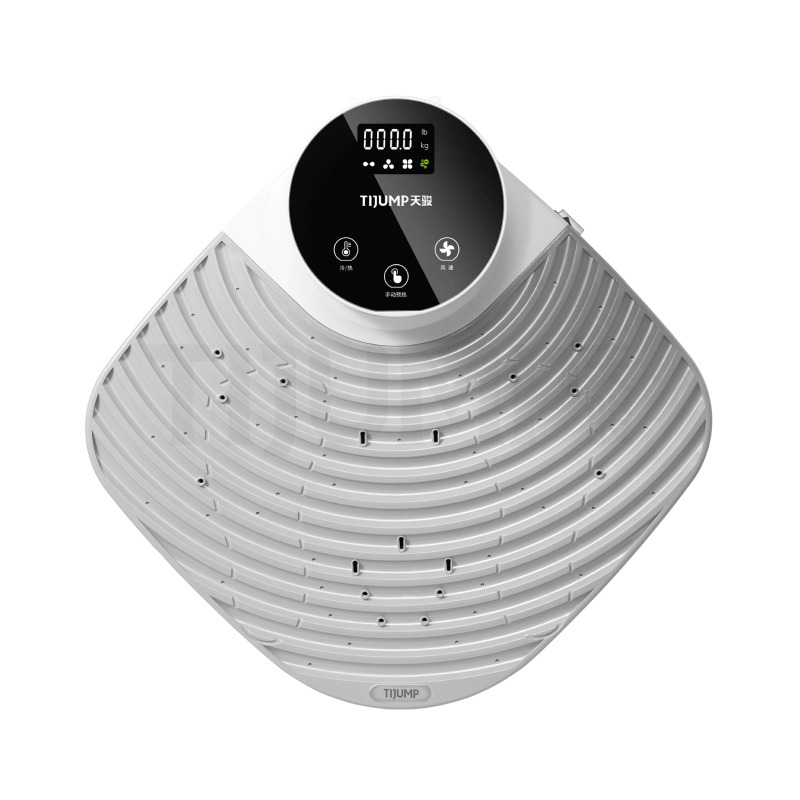
Floor-integrated systems function as platforms users stand on. The mechanism blows air upward along the body. This design completely eliminates wall space requirements. Installation often involves recessing the unit into the concrete slab or building a custom raised floor assembly to house the mechanical components flush with the finished tile.
An air shower body and feet dryer provides excellent lower-body drying. It struggles to maintain effective heat and velocity at the chest and head level of taller users. The distance and angle errors become too severe as the air travels upward. These units serve best as supplemental drying tools. They are ideal for environments prioritizing foot and leg care, such as specific accessible care facilities or diabetic treatment centers.
When selecting a system for a diverse user base, basic design categories are not enough. You must evaluate specific mechanical features that enhance adaptability. These features dictate how well the machine handles the transition between a tall adult and a seated user.
Fixed-angle slats limit a machine's utility. You must evaluate the necessity of manual or motorized louvers. These components allow users to direct airflow up or down based on their specific height. This simple mechanical addition effectively mitigates angle errors.
User-configurable directional vents provide immediate customization. A tall user can angle the top vents upward to catch their shoulders. A shorter user can angle those same vents downward to avoid taking airflow directly in the face. This adaptability transforms a rigid appliance into a flexible tool. Installers should verify that the louver mechanisms are built from corrosion-resistant materials to withstand the high humidity of a shower enclosure.
Advanced systems incorporate infrared or time-of-flight sensors. These sensors detect the user's height and position. They then activate only the air zones corresponding to that specific user. This targeted approach represents the highest level of height accommodation in modern fixtures.
The outcome of zone activation is twofold. First, it significantly reduces energy waste. There is no reason to power the top two feet of a panel if a child is using it. Second, it prevents blowing hot air directly into the faces of shorter users. It creates a customized air envelope based on real-time spatial data. A smart body drying machine utilizes these sensors to adjust blower speeds dynamically as the user moves.
Multi-user environments often include individuals with mobility challenges. You must evaluate how systems perform for wheelchair users or those utilizing shower seats. A system that only works for standing users fails the universal design test.
Criteria for seated efficacy are strict and governed by specific building codes. To ensure full compliance and usability, follow these verification steps:
Verify the clear floor space in front of the unit measures at least 30 inches by 48 inches to accommodate a wheelchair approach.
Ensure all physical controls, buttons, or touch panels are mounted between 15 inches and 48 inches above the finished floor.
Confirm the lowest air vents are not obstructed by the profile of a standard fold-down shower seat.
Test the airflow trajectory to ensure it hits the torso and legs at a perpendicular angle while the user remains seated.
Check that the unit does not protrude into the required turning radius of the bathroom layout.
Engineering a machine to serve everyone requires compromises. Maximizing one feature often diminishes another. Recognizing these trade-offs helps in selecting the most balanced system for your specific environment.
Delivering high-velocity air requires powerful motors. Accommodating taller users with a wall-mounted unit often places the top motor or blower directly at ear level. This creates a significant acoustic challenge, especially in bathrooms with hard tile surfaces that reflect sound waves.
You must evaluate the acoustic engineering of the unit. The goal is to deliver high velocity without exceeding safe decibel levels. Targeting an output of less than 70 dB is crucial for comfort. If a machine is too loud, users will turn it off before they are fully dry. Manufacturers mitigate this by utilizing sound-dampening enclosures or placing the primary blower motor lower in the unit, using internal ducting to reach the top vents.
Running a massive column of hot air requires substantial electricity. The trade-off becomes apparent when a small user operates a large machine. Running a 7-foot vertical panel to dry a 4-foot child wastes electricity and ambient heat. High-amperage heaters draw significant power, often requiring dedicated 20-amp or 30-amp GFCI-protected circuits.
You must compare the operational costs of different configurations. Single-motor, full-blast systems are simpler and often cheaper upfront. They lack efficiency. Multi-motor, zoned systems cost more initially but save power over time. A zoned Body Dryer only heats the air necessary for the person standing in front of it, optimizing energy consumption and reducing the load on the home's electrical panel.
System Configuration | Average Amperage Draw | Energy Efficiency Rating | Ideal User Demographic |
|---|---|---|---|
Single-Motor Full Panel | 20 - 30 Amps | Low (Heats unused zones) | Adult-only households |
Multi-Motor Zoned Panel | 15 - 25 Amps (Variable) | High (Targeted heating) | Families with children |
Overhead Single Blower | 15 - 20 Amps | Moderate | Single adults |
Even the most advanced machine fails if installed incorrectly. Real-world installation introduces variables that can destroy drying efficiency. Careful planning mitigates these risks before the mounting brackets are ever drilled into the tile.
Incorrect placement or mounting heights severely compromise performance. If a unit is mounted too high, the lower body remains wet. If mounted too low, the upper body is neglected. This slows down the drying process. It drives up energy use as users run the machine longer to compensate for poor coverage.
The secondary consequences of poor placement are severe. Failing to achieve even coverage leaves hidden moisture lingering on the body. Water trapped in skin folds, between toes, or underarms can lead to skin irritation. Over time, this consistent dampness promotes fungal issues. Proper placement is a matter of hygiene, not just convenience. Installers must also ensure the unit is sealed properly against the wall to prevent moisture from getting behind the housing and causing mold growth in the drywall.
Avoiding placement errors requires a strict calculation framework. You cannot guess the mounting height. You must calculate the coverage envelope of the specific unit. This ensures the airflow reaches all intended users.
To mitigate errors, measure the tallest and shortest primary users. If a unit covers 5 feet vertically, and your tallest user is 6 feet, you must mount the top of the unit at the 6-foot mark. This means the bottom of the unit sits 1 foot off the ground. This covers users from 1 foot to 6 feet tall. Always align the top vent with the shoulder height of the tallest user. Air naturally falls and expands, but it struggles to climb efficiently.
The surrounding environment drastically impacts perceived performance. You must address the risk of wind chill. Even with heated air, high-velocity airflow in a cold, drafty bathroom will feel uncomfortable. Rapid evaporation pulls heat away from the skin. If the bathroom exhaust fan is oversized, it will pull the heated air away from the user before it can effectively dry the skin.
Mitigation requires environmental control. Ensure the drying zone is enclosed or positioned away from direct ventilation drafts. Evaluate the appliance's internal heating element capacity, typically measured in kilowatts (kW). A higher kW rating compensates for cooler room temperatures. Maintaining a warm ambient bathroom temperature is the most effective way to ensure the forced air feels comfortable across all heights. HVAC contractors should balance the supply and return air in the bathroom to maintain a neutral pressure zone around the drying appliance.
Take the following steps to finalize your selection and prepare for installation:
Measure the shoulder height of the tallest user and the lowest required drying point to define your exact vertical coverage envelope.
Map the available wall space in your drying area, ensuring a minimum clearance of 2 to 6 inches between the user and the planned vent locations.
Request technical spec sheets from manufacturers detailing the effective airflow range, CFM, and decibel output at head level.
Verify with your electrician that your main panel can support the required dedicated amperage and voltage for systems utilizing multi-motor zoned heating.
Install solid marine-grade plywood blocking between the wall studs during the rough-in phase to support the weight of the chosen unit.
A: Yes, provided the unit features adjustable louvers or zoned airflow. These features allow you to direct heat downward. This prevents high-velocity air from blowing directly into a child's face while still effectively drying their body.
A: Mounting height depends on the unit's length and the tallest user. Generally, the top of the unit should align with the shoulders of the tallest user. This ensures full-body coverage without wasting energy heating the ceiling or leaving the lower body damp.
A: Floor-mounted units excel at drying the lower body. They often lose thermal efficiency by the time the air reaches the upper torso of a user over 6 feet tall. They are best paired with a warm ambient room temperature.
A: Specific models can be installed to meet ADA compliance. The controls must be placed within the required reach range, typically 15 to 48 inches above the floor. The airflow must effectively cover a seated user without requiring them to stand.
A: Yes. Due to thermal dissipation, moving just a few inches away from the air source significantly reduces the perceived heat and drying efficiency. Systems must be installed where users can comfortably stand within 2 to 6 inches of the vents.


