
Views: 0 Author: Site Editor Publish Time: 2026-08-20 Origin: Site
Garment maintenance has shifted from labor-intensive manual ironing to automated, hands-free systems. These machines promise professional-grade results at home while eliminating the clutter of traditional ironing boards and handheld steamers. Buyers face a saturated market of automated ironing gadgets and premium cabinets. This makes it difficult to distinguish between verifiable performance and exaggerated marketing claims regarding speed, fabric safety, and true hands-free convenience. By applying rigorous steam and vibration testing methodologies, this guide evaluates the actual efficacy of the modern clothing care machine. We provide a framework to assess which technology aligns with specific wardrobe demands and operational realities. You will learn how to evaluate hardware based on actual physics, moisture requirements, and mechanical tension.
Technology Realities: Effective automatic wrinkle removal relies on a precise combination of moisture (often requiring pre-dampened garments), sustained thermal output, and mechanical tension or vibration to relax fibers.
Format Matters: The market is divided into tension-based torso and pant dryers (best for individual, freshly washed items) and comprehensive steam closets (best for multi-garment refreshing and sanitization).
Performance Limitations: While automated systems excel at refreshing daily wear, polos, and synthetics, heavy-duty fabrics like crushed linen still require specific moisture-to-heat ratios that entry-level devices struggle to maintain.
Total Cost of Ownership: Evaluating these machines requires factoring in setup time, footprint, energy consumption, and ongoing maintenance (descaling) alongside the initial purchase price.
Understanding the baseline physics of wrinkle removal sets realistic success criteria for automated devices. It determines if they can truly beat hand ironing. Wrinkles form when polymer bonds within fabric fibers break due to heat or moisture during wearing or washing. These bonds then reset in a creased position as the fabric cools or dries. Reversing this process requires a precise application of energy to relax those bonds. Physical manipulation must follow to smooth the material before it sets again. Evaluating automated systems requires analyzing how effectively they replicate the traditional combination of a hot iron plate and manual pulling.
Continuous steam relaxes polymer bonds in fabric fibers fundamentally differently than the direct, high-heat compression of a traditional iron plate. A standard iron applies intense, localized surface heat. It physically crushes the fibers flat. Standard irons hit 300°F to 400°F, which physically damages synthetic polymers. This method works well for creating sharp creases but risks scorching delicate materials. It also degrades fiber integrity over time. Steam acts as a plasticizer. It penetrates the weave deeply, swelling the fibers and allowing them to return to their natural, uncreased state without severe compression. Steam systems operate around 212°F at the nozzle, dropping to 150°F as it hits the fabric. This temperature differential is why steam cannot burn clothes.
Evaluating the strict "only with damp garments" requirement heavily cited in entry-level machine instructions reveals the thermodynamics of drying and pressing simultaneously. When a device relies on forced hot air rather than an internal steam boiler, it requires the garment to supply the moisture. As the machine blows hot air into the damp fabric, it converts the residual washing machine moisture into steam directly within the fiber matrix. This internal steam generation forces the creases out as the garment dries. If the fabric is already dry, blowing hot air through it will not break the polymer bonds. The machine becomes largely ineffective on set-in wrinkles.
We observe specific phases during the steam penetration process:
Moisture Introduction: The fabric absorbs water vapor, causing the internal polymer chains to loosen.
Thermal Expansion: Heat increases the kinetic energy within the fibers, further relaxing the structural bonds.
Fiber Realignment: The relaxed fibers lose their creased memory and become pliable.
Moisture Evaporation: As the heat continues, the moisture evaporates, locking the fibers into their new, flat configuration.
Moving air, inflatable tension bladders, and physical vibration mechanisms reshape the garment while the fibers remain in a relaxed state. Once steam or internal moisture softens the fabric, the material must stay taut until it dries or cools. Inflatable bladders achieve this by expanding inside the garment. They create uniform outward pressure across the chest, back, and sleeves. Vibration systems, typically found in cabinet models, shake the garments at high speeds. This rapid oscillation mimics the sharp snap a tailor gives a fabric to align the weave.
The limitations of vibration without adequate steam density or proper garment mounting techniques become apparent during field testing. If a cabinet fails to generate a thick, sustained steam cloud, the vibration simply shakes dry, wrinkled cloth to no effect. Similarly, if a shirt hangs improperly or lacks sufficient bottom-weighting clips, the mechanical tension cannot distribute evenly. The vibration must work against a fixed point of resistance to pull the creases flat. Without that opposing force, the fabric merely flutters. Deep structural wrinkles remain intact along the placket and side seams.
Mechanical Action Comparison
Action Type | Mechanism | Primary Benefit | Limitation |
|---|---|---|---|
Inflatable Bladder | Outward air pressure | Uniform tension across torso | Stretches elastic collars |
High-Frequency Oscillation | Moving hanger rack | Dislodges dust and aligns weave | Requires heavy bottom weights |
Forced Airflow | High-velocity internal fan | Rapid moisture evaporation | Ineffective on dry garments |
Breaking down the hardware types available for residential and commercial use reveals distinct approaches to automated garment care. Options range from compact entry-level gadgets to permanent appliance installations. Each category utilizes different core technologies to address specific laundry workflows and fabric types.
These systems define the mechanics of inflatable, one-touch operation designed with specific attachments for shirts, pants, polos, and sweaters. The core unit consists of a high-velocity blower base and a heating element. A nylon balloon, shaped like a human torso or a pair of legs, attaches to this base. The user zips the damp garment over the deflated balloon, secures the cuffs, and activates the machine. The balloon rapidly inflates, filling the garment and applying outward tension while forcing hot air through the fabric weave.
The ideal use case centers on the 2-in-1 rapid drying and smoothing of single, freshly washed garments directly from the washing machine. By utilizing an automatic wrinkle removal machine immediately after the spin cycle, users bypass the tumble dryer entirely. This prevents heat-set wrinkles from forming and eliminates the need for subsequent ironing. These devices process standard cotton-blend button-downs and casual trousers rapidly. They prove highly efficient for daily uniform or office wear preparation.
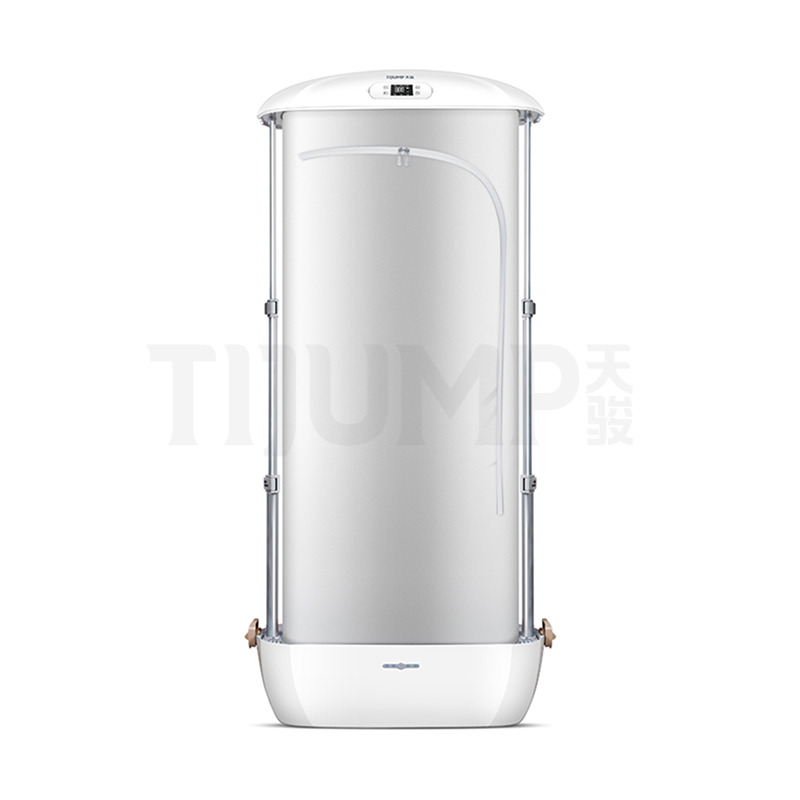
Premium, stationary units combine steam generation, gentle heat drying, and UV-C light into a single appliance resembling a narrow wardrobe. These units operate on a completely different principle than tension dryers. Instead of inflating the garment, they bathe hanging clothes in a controlled, high-humidity environment. Integrated boilers produce continuous, low-temperature steam that permeates the fabrics. Internal fans circulate the air to ensure even distribution across multiple garments simultaneously.
The multi-functional nature of a UV steam clothing care cabinet extends far beyond basic wrinkle reduction. Engineers design these units for bacterial elimination and deep odor removal without relying on chemical dry cleaning. The inclusion of UV-C lamps breaks down the DNA of odor-causing bacteria and neutralizes trapped particulate matter from smoke or food. This makes the cabinet an exceptional tool for refreshing delicate items like wool suits, cashmere sweaters, and silk dresses that cannot withstand standard machine washing or high-heat pressing.
High-capacity, oscillating hanger systems handle comprehensive daily wardrobe maintenance. These units physically shake the garments at high frequencies while injecting dense steam into the chamber. The oscillation helps dislodge dust and forces the steam deeper into heavy weaves like denim and tweed. They handle mixed loads, allowing users to refresh a suit jacket, a silk tie, and a cotton shirt in a single cycle.
Comparing the footprint and installation requirements against standalone tension dryers and traditional steamer stations reveals significant logistical differences. A clothing care steam closet demands dedicated floor space and vertical clearance. Plumbed units require a dedicated cold water line and a standpipe drain, identical to a washing machine setup. This prevents the user from constantly carrying heavy water reservoirs across the house. However, it restricts installation to laundry rooms or utility closets. Reservoir models offer flexibility for bedroom installation but require manual filling with distilled water every three to four cycles. In contrast, tension-based dryers remain highly portable. They often collapse into small storage bags that fit on a closet shelf when not in use.
Defining the metrics used to test and validate manufacturer claims against traditional hand ironing ensures realistic expectations. Automated systems must undergo evaluation based on their actual operational efficiency, their safety across various textiles, and their secondary hygiene benefits.
Analyzing the true operational time requires factoring in the time required to mount the garment, fill reservoirs, and achieve operational heat. Marketing materials frequently highlight a rapid 5-10 minute processing cycle. However, this metric often isolates the machine's run time, ignoring the setup phase. For tension-based systems, properly dressing the inflatable bladder takes time. Buttoning the collar, aligning the placket, securing the cuffs, and attaching weight clips can take two to three minutes per garment. If the machine requires pre-heating, this adds further delay.
Comparing the advertised cycle against actual drying and smoothing times for various fabric weights provides a clearer picture of efficiency. A lightweight synthetic polo may finish perfectly in eight minutes. However, a heavy 100% cotton oxford shirt often requires fifteen to twenty minutes of sustained forced air to dry completely and release deep creases. Factoring in the time saved by skipping the tumble dryer and avoiding the manual labor of standing at an ironing board, the net time savings remains highly favorable for the user.
Fabric Processing Time Metrics
Fabric Weight | Material Type | Average Setup Time | Active Processing Time |
|---|---|---|---|
Lightweight | Synthetic Polo / Silk | 2 Minutes | 8 - 10 Minutes |
Medium Weight | Cotton Blend Dress Shirt | 3 Minutes | 12 - 15 Minutes |
Heavyweight | 100% Cotton Oxford / Denim | 4 Minutes | 18 - 25 Minutes |
Assessing the "no burning" claims involves examining the maximum temperature outputs and forced-air distribution of these devices. Traditional irons pose a constant risk of scorching, melting synthetics, or creating shiny patches on dark wools due to direct plate contact. Automated systems eliminate this risk by utilizing ambient heat and steam. Forced-air tension dryers typically operate between 130°F and 150°F. These temperatures remain safe for almost all standard apparel.
Detailing testing outcomes on heavy-duty fabrics versus everyday workwear reveals clear performance boundaries. Crushed linen and heavy denim require intense, direct pressure and high heat to achieve a flat finish. Air tension and ambient steam struggle to fully smooth these materials. Conversely, everyday workwear, cotton blends, knits, and delicates respond exceptionally well. The gentle thermal regulation prevents shrinkage in sweaters and protects the delicate fibers of silk blouses. This offers a safer alternative to aggressive hand pressing.
Evaluating the secondary benefits of steam and UV exposure highlights their capability in neutralizing trapped particulate matter. Garments often absorb environmental odors without actually becoming physically soiled. Restaurant grease, cigarette smoke, or stale sweat embed deeply into the weave. Washing these items prematurely degrades the fabric and fades dyes.
Steam penetration causes fibers to swell, releasing trapped microscopic particles. The high humidity environment binds to odor molecules, pulling them out of the fabric as the steam dissipates. When combined with UV-C light, the sanitization efficacy significantly extends the time between dry cleaning visits. This capability transforms the machine from a simple wrinkle remover into a comprehensive fabric preservation system. It proves particularly valuable for outerwear and structured tailoring.
Mapping advertised features to tangible user benefits identifies the learning curve associated with these appliances. It separates practical utility from superficial technological additions.
Critiquing the "hands-free" label requires measuring the manual effort required to properly align collars, cuffs, and button plackets on tension machines. The actual processing phase operates autonomously, but the preparation remains highly manual. The technique required to maximize a machine's capabilities is strict. Improper mounting directly leads to set-in creases. If a user hastily throws a shirt over the balloon and leaves the button placket misaligned, the machine will dry the fabric into that crooked shape. This requires a complete re-wash to fix.
When setting up a tension dryer, the user must ensure the nylon bladder matches the garment size. Zipping the lateral expansion gussets prevents the machine from over-stretching a medium shirt into a large. The cuffs must be clamped tightly; otherwise, the forced air escapes through the sleeves, dropping the internal pressure and leaving the torso wrinkled.
Users must carefully button the garment to the top to ensure structural integrity during inflation.
Sleeves require smoothing and untwisting before the air cycle begins.
Weight clips need strategic placement on the front and back hems to provide downward resistance against the upward airflow.
Collar shaping demands manual adjustment to prevent the points from curling outward under tension.
Cuff tensioners must lock securely to prevent the sleeve ends from shrinking during the drying phase.
Assessing the utility of app integration, remote start capabilities, and cycle monitoring in premium cabinets reveals mixed practical applications. A remote control garment care dryer allows users to monitor progress from their smartphone. They receive alerts when water reservoirs run low or get notified when a cycle completes. Because the process inherently requires physical garment loading and precise hanging, remote start functionality offers limited real-world convenience.
Determining if smart features justify their inclusion depends on the software ecosystem. The true value of app integration lies in the ability to download specialized, fabric-specific care cycles not pre-programmed on the machine's physical control panel. Downloading a specific low-heat, high-oscillation cycle designed exclusively for cashmere provides tangible value. It enhances the machine's core function and protects expensive garments.
Comparing the spatial requirements of different systems dictates their feasibility for various living situations. Collapsible tension machines offer immense scalability. They eliminate the need for a bulky ironing board and disassemble into a compact footprint. Users easily store them under a bed or on a closet shelf. This makes them highly suitable for apartments or homes with limited utility space.
Permanent steam closet installations demand significant spatial commitment. They require rigid floor space, proximity to electrical outlets, and clearance for door swings. They offer superior convenience by eliminating the setup friction of inflatable bladders. However, their size and weight make them a permanent fixture in a laundry room or master closet. This requires careful pre-purchase measurement and spatial planning.
Installation and Spatial Requirements
System Category | Footprint | Portability | Plumbing Requirement |
|---|---|---|---|
Collapsible Tension Dryer | Minimal (2 sq. ft. active) | High (Stores in a bag) | None |
Reservoir Steam Cabinet | Moderate (4-6 sq. ft.) | Low (Heavy, wheeled base) | None (Manual fill) |
Plumbed Steam Closet | Large (Built-in dimensions) | Permanent Fixture | Direct water line and drain |
Identifying the hidden drawbacks and maintenance realities of automated clothing care ensures users adopt the right system for their specific habits and infrastructure.
Discussing the workflow disruption of needing garments to be damp right out of the wash highlights a major conceptual trade-off for tension-based dryers. These machines prove completely ineffective on dry, heavily wrinkled clothes pulled from a crowded closet or a neglected laundry basket. The fabric must contain residual moisture for the forced hot air to generate the internal steam necessary for wrinkle release.
This dependency forces users to alter their laundry habits. Instead of transferring an entire load from the washer to the tumble dryer, the user must intercept specific shirts or pants immediately after the spin cycle. If the garments sit in the washing machine too long and begin to air dry, the tension machine's effectiveness drops significantly. This often requires the user to manually re-dampen the fabric with a spray bottle before processing.
Detailing the necessity of distilled water usage and regular descaling routines exposes the ongoing maintenance requirements of steam-generating appliances. Any device that boils water remains susceptible to mineral buildup. Hard water contains calcium and magnesium. When water boils into steam, these minerals remain behind, coating the heating element. Over time, this scale acts as an insulator, forcing the element to work harder and eventually burn out. Users must run a 50/50 mix of white vinegar and distilled water through the system monthly, followed by two clean water flush cycles to remove the acidic smell.
Examining the durability of inflatable nylon bags, zipper mechanisms, and weight clips on tension-based models reveals potential failure points. The nylon bladders endure continuous high heat and intense outward pressure. Over time, the material degrades. The zippers used to adjust the balloon size from small to XXL can jam or separate under stress. These components act as wear items and eventually require replacement to maintain the necessary airtight tension.
Analyzing the wattage draw of continuous steam and forced-air heating elements is critical for safe home integration. These machines utilize powerful heating coils and high-velocity fans. They frequently draw maximum amperage from standard household circuits. A standard tension dryer pulls 1500 watts during the heating cycle. This is equivalent to a high-end space heater. If plugged into a shared 15-amp bedroom circuit alongside a television and lights, it pushes the breaker to its absolute limit. Users must identify dedicated circuits to prevent nuisance tripping during the morning routine.
Reviewing safety features remains paramount. Devices left unattended while generating high heat must possess robust safety mechanisms. Auto-shutoff timers, tip-over protection switches, and thermal fuses act as critical components. If a tension dryer's fan motor fails while the heating element remains active, the thermal fuse must immediately sever the power. This prevents the nylon bladder from melting or igniting.
Audit your primary wardrobe fabrics to determine the ratio of heavy cottons to synthetics before selecting a machine type.
Measure your available laundry room or closet floor space to confirm clearance for a permanent cabinet door swing.
Install a dedicated 15-amp circuit if you plan to run a high-capacity steam closet alongside other heating appliances.
Establish a monthly maintenance schedule for descaling the water reservoir using a manufacturer-approved acidic solution.
A: They replace the need for hand ironing for everyday wear, but they do not replicate the crisp, sharp creases achieved by the direct heat and pressure of a traditional iron. Automated systems provide a soft press, ideal for polos, t-shirts, and casual button-downs, rather than stiff formal wear.
A: Yes. Many tension-based systems come with specific inflatable attachments designed to accommodate the shape and weight of pants, polos, and knit sweaters. These attachments ensure the correct tension applies to different garment structures without stretching the fabric out of shape.
A: The cabinet utilizes a combination of continuous steam penetrating the fabric fibers to release trapped particulate matter, while UV-C light neutralizes odor-causing bacteria. This dual-action process effectively eliminates smoke, sweat, and food smells without the mechanical stress of washing.
A: Premium steam closets handle dry clothes by generating their own heavy moisture and steam. However, entry-level tension dryers strictly require the garment to be damp right out of the washing machine for effective wrinkle release and drying.
A: These machines eliminate the need for a large, flat ironing surface, freeing up significant storage space in your home. However, you may still want to keep a small handheld steamer or a compact iron for quick touch-ups on stubborn collars and cuffs.


